Garage door repair in Norman, Oklahoma
You hear what is actually wrong, before anything is touched
Every visit runs the same way. The door is cycled and balanced by hand, the worn component is put in front of you, and you are told which repairs matter today and which ones honestly do not. Then you decide what gets done.
Call (405) 555-0128Request a callback
Free estimate. Open seven days, 7:00 AM to 7:00 PM.
Sorted by what the door is doing
Start with the symptom, not the part name
Almost nobody can name the component that failed, and there is no reason they should have to. Describe the behaviour instead: the noise, when it started, whether anything changed recently.
It will not open, or it will not close
Usually a broken spring, or a door that has come out of its tracks. Both are load-bearing failures worth stopping the door over.
- Spring repair and replacement
- Off-track and misaligned door correction
It is loud, or it moves unevenly
Grinding, banging and jerky travel trace back to rollers, cables or track alignment. Caught early, this is a small job.
- Cable, roller and track repair
- Annual maintenance and tune-up
The opener or the remote will not respond
Sometimes the opener, often the safety sensors, occasionally a flat keypad battery. The check tells you which before anything is replaced.
- Opener repair and installation
A section is damaged, or the door looks tired
A dented or split panel can often be swapped on its own rather than replacing the whole door. You are told which yours is.
- Panel replacement
- New residential door installation
It is a business door and it has stopped
Roll-up and sectional doors on a loading bay fail differently to a home door, and they are usually holding somebody up.
- Commercial and roll-up doors
A broken door is not a problem you have to solve tonight
It is a thing that needs looking at by somebody who will tell you what it is. Call and describe it.
What actually happens on the visit
Four steps, and you are standing there for all of them
There is no part of this that happens out of sight. The whole point of working this way is that the visit ends with you understanding what failed and why, rather than holding a list of parts you had no way to check and a total you had no basis to question.
You describe the behaviour
On the phone, in whatever words you have. Nobody needs the correct term for the part. What the door does, when it started, whether it happens every time or only sometimes, and whether anything changed recently is enough to know what to bring and roughly what is coming.
The door is tested before anything is opened up
The door is run through a full cycle, then the opener is disengaged and the balance is checked by hand — a correctly balanced door will hold its position halfway. After that the tracks, cables, rollers, hinges and springs are looked over in order. This is where the real fault is found, and it is the step most people never get shown.
You are shown the part and told what it means
Whatever failed comes off the door and gets put in your hand, with an account of what caused it and what happens if it is left. If two different repairs would both work, you hear about both of them, including the cheaper one, and including the one that involves doing nothing for now.
You decide what gets done today
Some items are safety items and genuinely should not wait — a frayed lift cable, a cracked spring, a safety reverse that no longer triggers. Others can sit for a year without consequence. You are told which is which, nothing is started until you have said yes to it, and the estimate is free.
You keep the explanation
The point of naming the parts aloud is that the next noise is a shorter conversation. Two years from now you will be able to say which end of the door it is coming from and roughly what it sounds like, and that alone takes most of the guesswork out of the following call. It is usually the difference between one visit and two, which is worth more to you than it is to us.
Why we work this way
A garage door is an easy thing to be vague about
It is heavy, it is under tension, it lives above your car, and almost nobody has any reason to know how it works. That combination makes it very easy for a repair visit to turn into a list of parts you cannot verify and a total you have no basis to question.
We would rather hand that knowledge back. If a spring is done, you get shown the break. If the rollers are worn, you get to feel the play in them yourself. If the opener is fine and the real fault is a sensor a foot out of line, you are told that too, even though the smaller job is the smaller invoice.
That is the whole proposition. Not the fastest van in the metro and not the biggest crew — an accurate description of what is wrong with your door and an honest account of what putting it right involves, given to you before any work starts rather than explained afterwards.
It also tends to make the next call easier. Once you have seen how your own door is put together, and heard the parts named while you were standing next to them, a strange noise two years from now becomes a much shorter conversation than it would otherwise have been.
Before you call
Four things worth checking yourself
None of these need tools and none of them involve touching a spring. They will not fix a broken door, but they occasionally save a visit.
Look at the photo-eye sensors
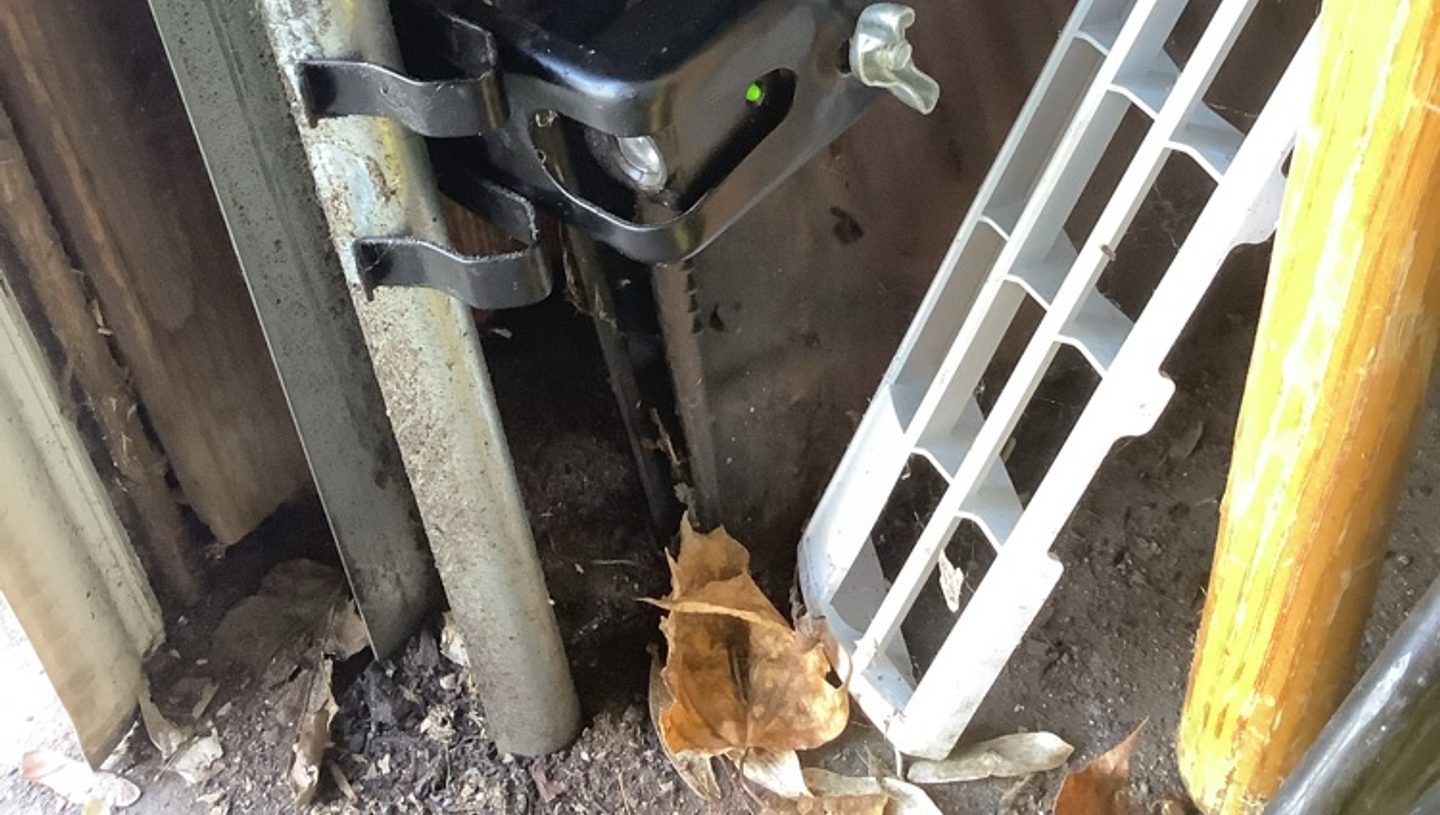
Two small units near the floor on either side of the opening. If one is knocked out of line, or a bin or a leaf is sitting in the beam, the door will refuse to close.
Try the wall button rather than the remote
If the wall button works and the remote does not, the door itself is fine and you have a remote or keypad problem. That is a much smaller conversation.
Look along the springs above the door
You are looking for an obvious gap in the coil. If you can see a clear break, stop using the door and do not try to lift it by hand or adjust anything.
Listen for where the noise is coming from
Noise at the top near the opener, noise along the tracks and noise from the rollers all point somewhere different. Even a rough sense of where narrows it down.
If a spring has broken or the door has come off its tracks, leave it alone and call.
What you can expect on the visit, stated plainly rather than promised vaguely
The fault is shown to you
Not described afterwards.
You hear what can wait
Not everything is urgent.
Options are compared aloud
Including the cheaper one.
The estimate is free
Given before any work.
Open seven days
7:00 AM to 7:00 PM.
Homes and businesses
Sectional and roll-up.
Worth saying directly
Two repairs that are genuinely not worth doing yourself
Most of a garage door is approachable, and it is more useful to say which parts are than to imply that all of it needs a professional.
Springs carry the weight of the entire door. They are wound under enough tension to break bones when they let go, and they let go without warning. The lift cables are the same story. Replacing either is a job for somebody with winding bars.
Sensors, remotes, keypads, weather seal and loose hardware are all fair game.
Ask for a callback
Leave a number and a rough description of what the door is doing, then pick a window that suits you. You will get a call inside that window from somebody who can talk through what it probably is, and what checking it involves, before anyone is scheduled to come out.
Nothing is booked from this form and no estimate is charged for. It is a request to talk, not an order, and you are not committed to anything by sending it.
We call, and that is the only way we get in touch. We do not write, and there is no list to be added to.
What customers say
The tech popped the panel off the opener, showed us the burnt-out capacitor, and explained exactly why it failed before quoting anything. Door has worked perfectly since. — Karen M.
Called about a spring that let go on a Sunday morning. Someone answered, walked me through what not to touch, and had it replaced by early afternoon. Straightforward the whole way through. — Devon R.
Our shop door was dragging on one side for months. Turned out to be a bent track, not the motor we assumed. Fixed in under an hour and they showed us the bend before straightening it. — Priya S.
Talk it through first
Describe what your door is doing and hear what that usually means
Call and say it in whatever words you have. You will get a plain account of what that behaviour normally points at, what checking it involves, and whether the door is safe to keep using in the meantime.
Rather not talk right now? Ask for a callback, pick a window inside opening hours, and the same person rings you back.
Where to find us
The workshop is in Norman, and that is where the vans start and finish. Serving Norman and the surrounding south metro communities.
Not sure whether you are inside that? Call and ask. It is a quicker answer than a map can give you and there is no charge for asking.
908 Larkfield Row, Norman, OK 73069